
If your workers’ compensation claim has been denied, delayed, or decided in a way that does not reflect the facts of your injury, you may feel like you have run out of options.
In California, injured workers do not always have to accept an unfavorable decision. There is a formal appeals process for disputed workers’ compensation decisions, and one of the most important agencies involved is the Workers’ Compensation Appeals Board, often called the WCAB.
The WCAB reviews certain decisions made in California workers’ compensation cases. It does not replace the insurance company, and it does not automatically give every injured worker a new hearing. Instead, it reviews whether a workers’ compensation judge made a legal or factual error that may justify reconsideration.
The process is technical, deadline-driven, and difficult to handle without legal guidance. If you are considering an appeal, it is important to understand how the WCAB works and what deadlines apply.
Have questions about your workers’ compensation appeal?
Call Kneisler & Schondel at (707) 542-5132 for a free consultation.
What Is the Workers’ Compensation Appeals Board?
The Workers’ Compensation Appeals Board is a California judicial body that reviews certain disputes in workers’ compensation cases.
In many cases, an injured worker first deals with an insurance claims adjuster. If the worker and the insurance company cannot resolve the dispute, the case may go before a Workers’ Compensation Judge, also known as a WCJ. After the judge issues a decision, either side may have the right to ask the WCAB to review it.
The WCAB serves two main functions:
- It reviews petitions for reconsideration of workers’ compensation judge decisions.
- It helps regulate the workers’ compensation adjudication process through rules of practice and procedure.
The WCAB is specific to California. Every state has its own workers’ compensation system, so the WCAB only handles California workers’ compensation matters.
How Does a Workers’ Compensation Case Reach the WCAB?
Most injured workers do not start their case at the WCAB. A case usually reaches the WCAB only after a dispute has already gone through earlier stages of the workers’ compensation process.
Here is the general path:
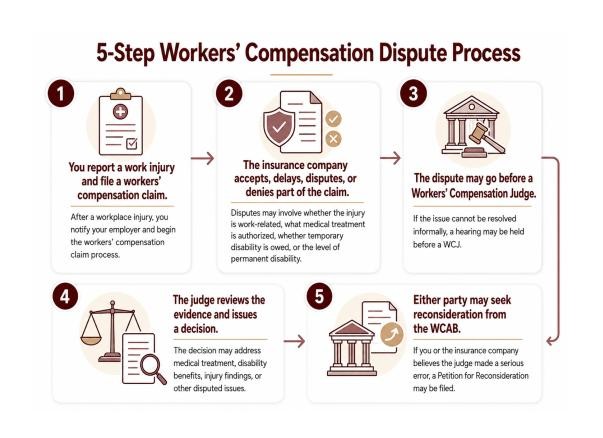
The WCAB does not simply restart the case. It reviews the judge’s decision based on specific legal standards.
What Is a Petition for Reconsideration?
A Petition for Reconsideration is a formal request asking the WCAB to review a final decision, order, or award issued by a workers’ compensation judge.
This is one of the main ways to appeal an unfavorable decision within the California workers’ compensation system.
A petition may be appropriate when there is a serious dispute about the outcome of your case, such as:
- Your claim was denied.
- Your temporary disability rate was calculated incorrectly.
- Your permanent disability rating is disputed.
- Medical treatment was denied.
- The judge misunderstood or misapplied the law.
- Important evidence was not properly considered.
- The decision is not supported by the evidence presented.
A Petition for Reconsideration should do more than say you disagree with the result. It must explain the legal and factual reasons why the WCAB should review the decision.
You can download the Petition for Reconsideration form directly from the California Department of Industrial Relations: dir.ca.gov/wcab. Completed petitions are filed with the WCAB office in San Francisco, though your local district office may also be involved depending on your case.

The 20-Day Deadline to File a Petition for Reconsideration
The deadline to file a Petition for Reconsideration is one of the most important parts of the WCAB process.
In most cases, a party has 20 days from the date the workers’ compensation judge’s decision was served to file a Petition for Reconsideration.
This is a strict deadline. If you miss it, you may lose the right to challenge the decision at the WCAB level.
That is why it is important to speak with a workers’ compensation attorney as soon as possible after receiving an unfavorable decision. Waiting too long can seriously limit your options.
Where Do You File a Petition for Reconsideration?
Petitions for reconsideration are generally filed through the Electronic Adjudication Management System, known as EAMS, or with the WCAB district office that has venue over the case.
For injured workers, this can be confusing because the correct filing location may depend on where the case was heard and what type of decision is being challenged.
If you are represented by an attorney, your attorney can prepare the petition, file it correctly, and make sure the appropriate parties are served.
How Does the WCAB Review a Petition?
Once a Petition for Reconsideration is properly filed, the WCAB reviews the petition and the underlying judge’s decision.
The petition is typically assigned to a three-member panel of WCAB commissioners. The panel reviews the record and determines whether reconsideration should be granted, denied, or dismissed.
The panel may:
- Dismiss the petition if it was filed late or does not meet procedural requirements.
- Deny the petition and leave the judge’s decision in place.
- Deny the petition but issue its own opinion explaining the decision.
- Grant reconsideration and send the case back for further proceedings.
- Grant reconsideration and issue a new decision, depending on the circumstances.
The WCAB usually reviews the written record. It generally does not hold a brand-new trial or allow the parties to simply present the same case again.
That means the quality of the original record matters. Medical reports, hearing testimony, legal arguments, and evidence presented before the judge can all affect what happens on appeal.
What Does the WCAB Look For?
The WCAB is not there to reconsider a case just because one side is unhappy with the result. It looks for issues that may justify review under California workers’ compensation law.
Common issues may include:
- The workers’ compensation judge made a legal error.
- The judge’s findings were not supported by substantial evidence.
- The judge failed to consider important evidence.
- The decision was based on an incorrect interpretation of the medical record.
- The judge abused discretion.
- The decision was unfair because of a procedural problem.
This is why a strong Petition for Reconsideration needs clear legal reasoning. The petition should explain what went wrong, why it matters, and what outcome should follow.
How Long Does the WCAB Take to Decide?
The WCAB has a limited period to act on a Petition for Reconsideration. In general, the WCAB must act within 60 days after the petition is filed. If no action is taken within that window, the petition may be denied by operation of law.
The exact timing can vary depending on the case, the issues involved, and the WCAB’s review process.
Even though the review process may move quickly, the impact can be significant. A WCAB decision may determine whether a judge’s decision stands, whether further proceedings are needed, or whether another level of review should be considered.
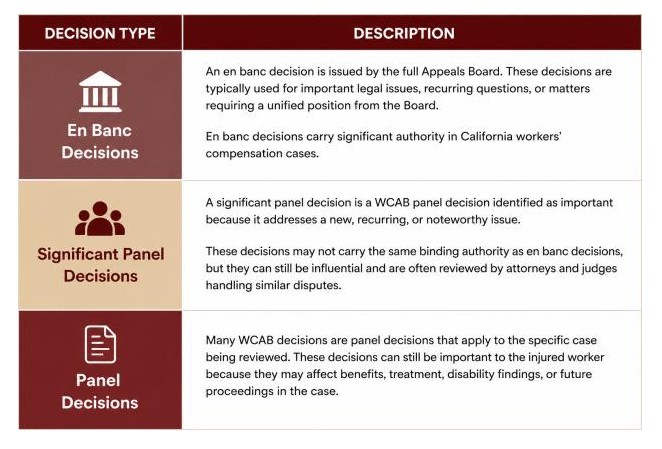
Types of WCAB Decisions
Not every WCAB decision has the same effect beyond the individual case. Some decisions are limited to the parties involved, while others carry broader importance within the workers’ compensation system.
Can You Appeal a WCAB Decision?
In some cases, a party may seek review beyond the WCAB by filing a petition for a writ of review with the California Court of Appeal.
This is a separate appellate process and is more complex than filing a Petition for Reconsideration. It usually requires legal representation because the court system has its own rules, procedures, and deadlines.
If the WCAB denies reconsideration or issues a decision that negatively affects your case, you should speak with an attorney immediately about whether further review is available.
Should You File a Petition for Reconsideration on Your Own?
You have the legal right to file a Petition for Reconsideration without an attorney. But doing so can be risky.
A WCAB appeal is not just a letter explaining why you are upset with the decision. The petition must identify specific legal or factual problems with the judge’s ruling. It must also be filed correctly, served properly, and submitted within the required deadline.
There are several reasons to consider working with a workers’ compensation attorney:
- The procedural deadlines are strict.
- Procedural mistakes can lead to dismissal.
- The petition must be based on valid legal grounds.
- The insurance company may be represented by experienced attorneys.
- The WCAB review is usually based on the existing record, not a fresh start.
- An attorney can evaluate whether reconsideration is the right strategy.
If your benefits, medical care, or disability rating are at stake, this is not a process you want to approach casually.
Call Kneisler & Schondel at (707) 542-5132
or fill out the online contact form for a free case review.
Frequently Asked Questions About the WCAB
What does the Workers’ Compensation Appeals Board do?
The Workers’ Compensation Appeals Board reviews certain decisions in California workers’ compensation cases. It can review petitions for reconsideration, issue decisions, and oversee parts of the workers’ compensation adjudication process.
What is the deadline to file a Petition for Reconsideration?
20 days from the date the WCJ’s decision is served. This is a hard deadline — missing it generally forfeits your right to appeal at the WCAB level.
Is the WCAB the same as the insurance company?
No. The WCAB is not the insurance company. It is a California judicial body that reviews disputes in workers’ compensation cases. The insurance company is one of the parties involved in the claim.
What is a Petition for Reconsideration?
A Petition for Reconsideration is a formal request asking the WCAB to review a final decision from a workers’ compensation judge. It must explain the legal or factual reasons why the decision should be reconsidered.
What is the deadline to file a Petition for Reconsideration?
In most cases, the deadline is 20 days from the date the judge’s decision was served. This is a strict deadline, so it is important to act quickly.
Does the WCAB hold a new hearing?
Usually, no. The WCAB generally reviews the written record from the case, including the judge’s decision, evidence, medical reports, and legal arguments. It usually does not hold a brand-new hearing where the case starts over.
How long does the WCAB take to decide a Petition for Reconsideration?
The WCAB generally must act within 60 days after a Petition for Reconsideration is filed. Timing can vary depending on the case and the issues involved.
What happens if the WCAB denies reconsideration?
If the WCAB denies reconsideration, the workers’ compensation judge’s decision may remain in place. In some cases, further review may be available through the California Court of Appeal.
Can I file a Petition for Reconsideration without an attorney?
Yes, but it can be risky. The process involves strict deadlines, technical filing rules, and legal arguments. If your benefits or medical care are at stake, it is wise to speak with a workers’ compensation attorney before filing.
Is there a fee to file a Petition for Reconsideration?
Injured workers generally do not pay a filing fee to file a Petition for Reconsideration in a California workers’ compensation case.
Talk to a Northern California Workers’ Compensation Attorney
The Workers’ Compensation Appeals Board process is governed by strict deadlines, detailed procedural rules, and legal standards that can be difficult to navigate without help.
If a workers’ compensation judge’s decision did not reflect the full facts of your injury, if your benefits were denied, or if you believe legal errors were made in your case, you may have options. But you need to act quickly.
At Kneisler & Schondel, we represent injured workers throughout Northern California in workers’ compensation matters, including disputed claims and appeals before the WCAB.
The insurance company has attorneys working for them. You deserve experienced legal support, too.
Call Kneisler & Schondel today at (707) 542-5132 or fill out the online contact form. Your initial consultation is free.